
Decorative Wood Carving by Alexander Grabovetskiy
Decorative wood carving is like jewelry for a room. One carved piece on a plain mantel can change the whole wall. You don't have to rebuild the kitchen or tear out the cabinets to get it.
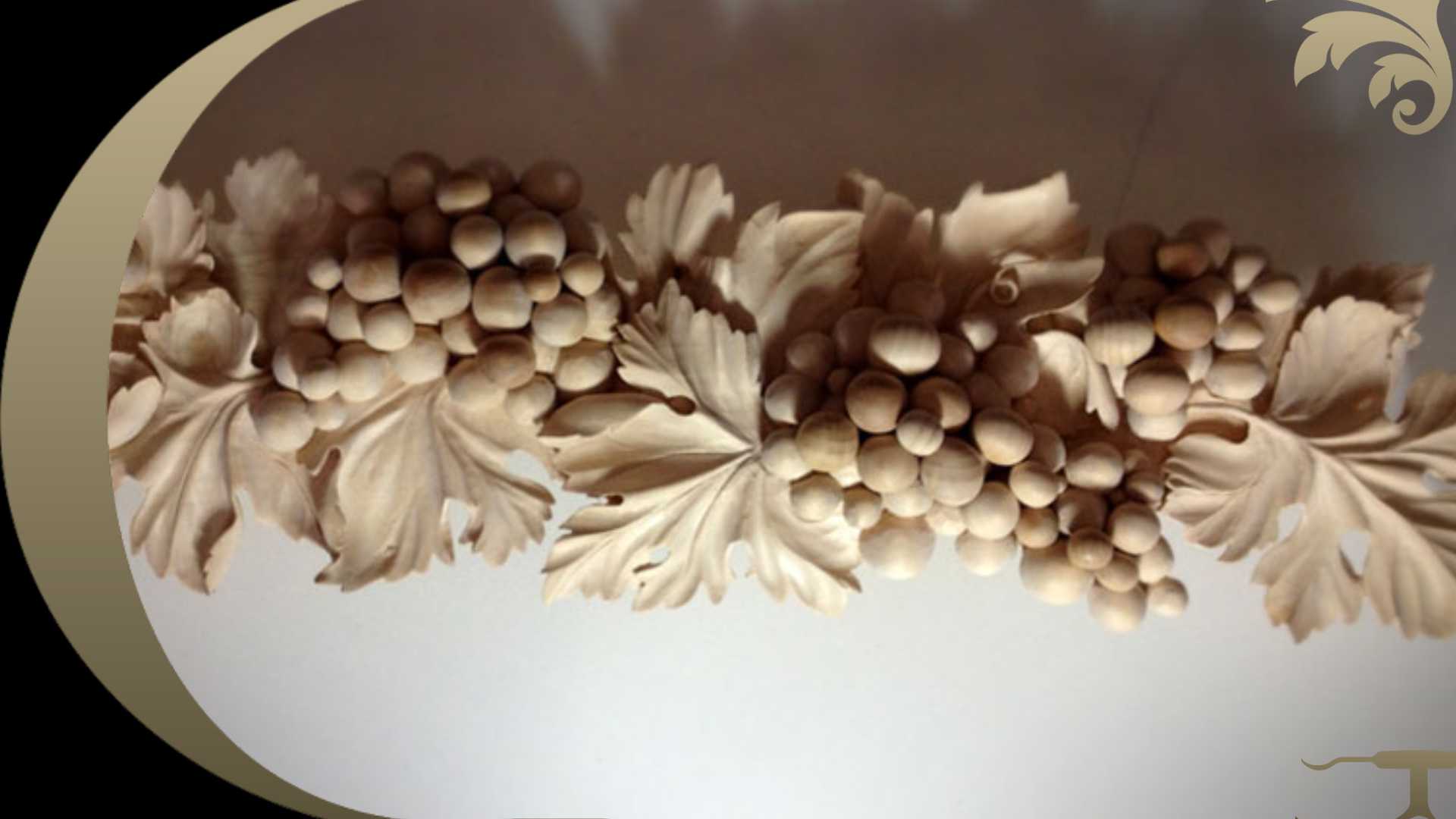
Sometimes a single onlay is enough. An onlay is a carving made on its own and then glued or pinned onto furniture or a panel. My grapevine is one of those: a long vine with leaves and heavy clusters, cut deep so the grapes look round and full. It can sit on top of a cabinet, over a door, or across a headboard.
Flowers, fruit and ribbon
Most decorative carving comes out of the garden. Flowers, fruit, shells and ribbon have been carved on European furniture for centuries, and they still feel fresh when the cutting is good. English carvers in Chippendale's time put them on mirrors and chairs, and the French did the same under Louis XV.
Sunflowers look simple and are hard to carve well. The center is a field of small seeds, and each one has to be cut on its own or the flower goes flat and dead. The petals have to twist a little, the way real ones do in the sun. Mine were carved in limewood in 2019.

Good decoration doesn't shout. It sits in the room like it was always there.
If your house has a spot that feels unfinished, send me a picture of it. For ideas, look through the sunflowers and florals or the carved frames and mirrors, where the flowers and ribbon are gilded.
The work as historical study
Every commission I take starts as a research project, and only then becomes an order. Before anything is carved, I study the piece. I trace the motif back to its period and to the carvers who made it famous, like Grinling Gibbons in England, and I try to understand how their hands thought and moved. That way a skill that is slowly disappearing gets carried into one more new piece, the way carvers have worked for centuries.
That is why every carving from my shop is the only one of its kind. It is my reading of a historical style, never a copy taken from a pattern, and the grain, the line of each leaf and the depth of every undercut come out of that study. No two pieces come out the same. I don't make mass-produced objects. What you receive is a finished carving with the research, the design and a whole life of work behind it, and a small piece of an old art that did not get lost.
Every commission starts with a conversation.
Tell me about your project: a single ornament or a full architectural scheme.
Discuss Your Vision