
Woodcarving Master

I learned what a tool really is in prison. I was eighteen when they arrested me for my faith, and nobody gives you a gouge in a place like that.
As the Soviet Union fell apart, the men around me were starving on prison soup. A mafia boss decided to protect me. I made a small knife, ten millimeters wide, and a tiny gouge out of a nail. With those two tools I carved furniture for him, and I used an old staining method from the fifteenth century that made the wood look like inlay. He sold the pieces to the prison administration.
One potato a day
My pay was one boiled potato a day. I shared it with the other men while we talked about God. I dropped below eighty pounds. In winter it was forty below with no heat, and I woke up covered in frost.
One potato.
I tell this because it changed how I see tools. A master isn't the man with the best tools in the shop. A master is the one who understands the tool he has, even if it's a nail. My teacher told me years before, "Think like a tool," and in that cell I finally understood him.
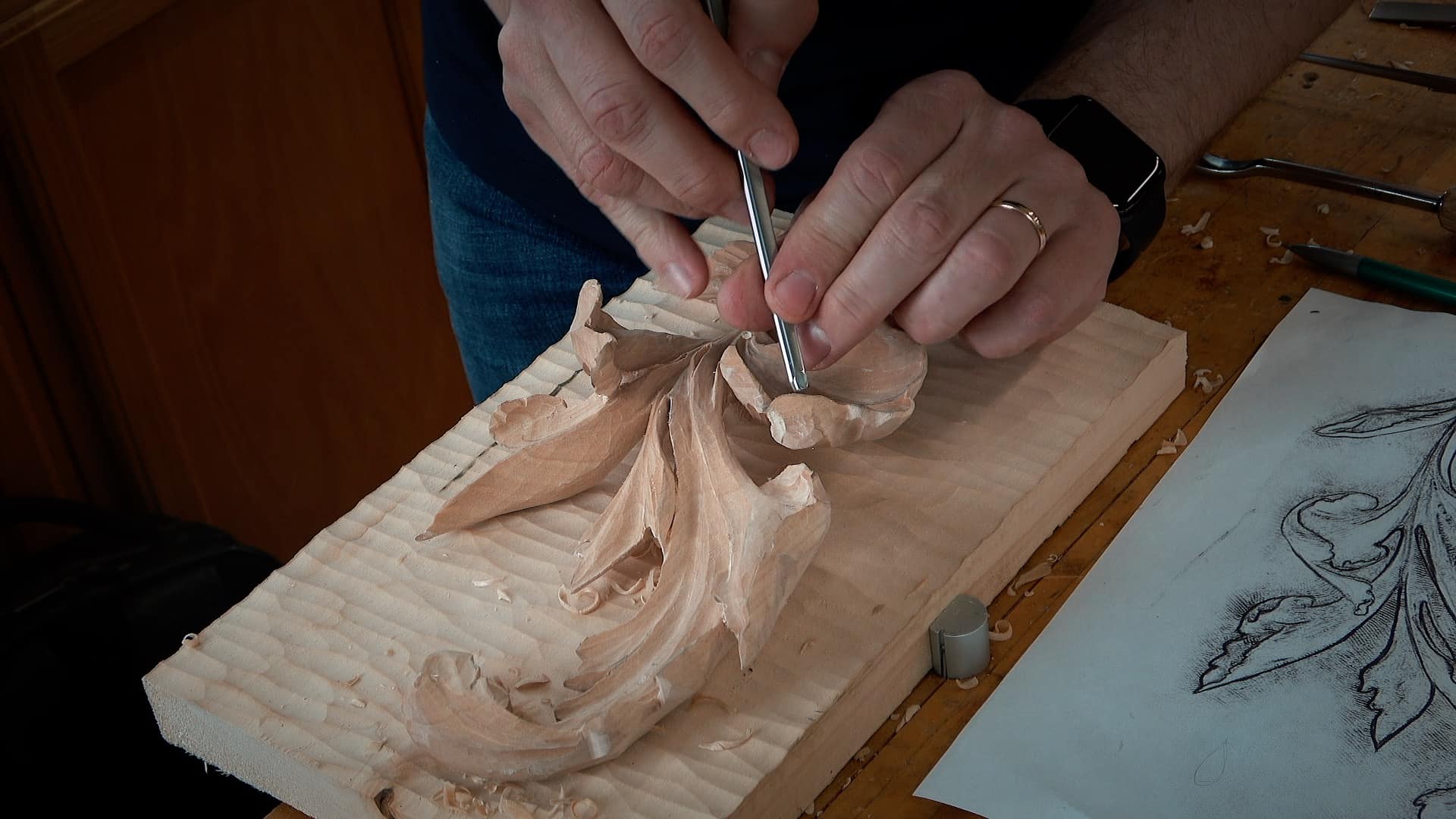
Today I have good gouges, and I take care of them like old friends. In 2012 my work earned me International Woodcarver of the Year. You can read the Wikipedia article about me, see the work in the collections, or write to me about a carving.
The work as historical study
Every commission I take starts as a research project, and only then becomes an order. Before anything is carved, I study the piece. I trace the motif back to its period and to the carvers who made it famous, like Grinling Gibbons in England, and I try to understand how their hands thought and moved. That way a skill that is slowly disappearing gets carried into one more new piece, the way carvers have worked for centuries.
That is why every carving from my shop is the only one of its kind. It is my reading of a historical style, never a copy taken from a pattern, and the grain, the line of each leaf and the depth of every undercut come out of that study. No two pieces come out the same. I don't make mass-produced objects. What you receive is a finished carving with the research, the design and a whole life of work behind it, and a small piece of an old art that did not get lost.
Every commission starts with a conversation.
Tell me about your project: a single ornament or a full architectural scheme.
Discuss Your Vision